


Not Affected by Ad Blockers
Unlike display and video ads, digital audio advertisements are typically not blocked by ad-blocking software, ensuring that your message reaches the intended audience without disruption.
 United States (USD)
  Australia (AUD)
  Germany (EUR)
  Austria (EUR)
  Switzerland (CHF)
Please change the country to one that uses the same currency as used in the shopping cart using the menu in the top right hand corner and re-add the items to your shopping cart.

How can we help you?

Please change the country to one that uses the same currency as used in the shopping cart using the menu in the top right hand corner and re-add the items to your shopping cart.
Since streaming services like Spotify, Pandora, or YouTube have grown in popularity, digital audio advertising has become a compelling way to connect with audiences. Businesses of all sizes are tapping into digital audio ads to enhance brand visibility, drive engagement, and boost sales. But does this advertising format align with your marketing goals?
Below, we break down the key advantages and challenges of digital audio advertising to help you make an informed decision.
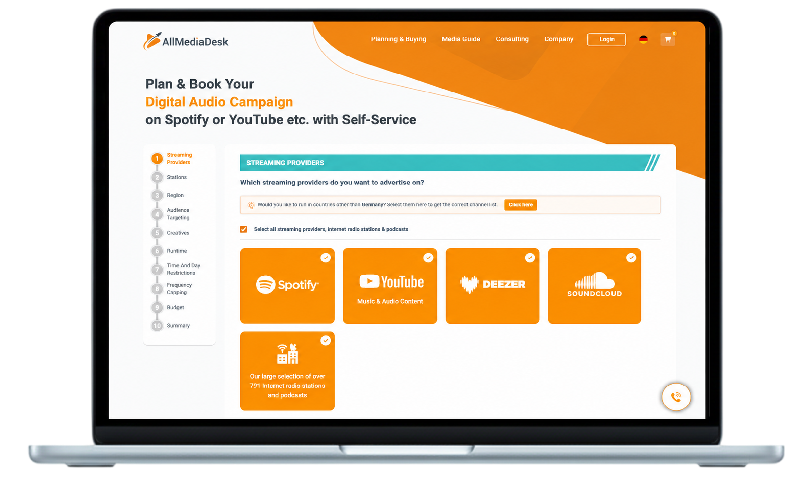
AllMediaDesk offers an easy-to-use self-service tool to book your Digital Audio Campaign.
 Start planning your online audio campaign
Unlike display and video ads, digital audio advertisements are typically not blocked by ad-blocking software, ensuring that your message reaches the intended audience without disruption.

Digital audio ads are often consumed in an environment with fewer distractions, whether people are commuting, exercising, or unwinding. This leads to increased attentiveness and stronger message retention compared to other ad formats.

Compared to traditional broadcast advertising, digital audio ads provide a cost-efficient way to reach specific target groups. Unlike traditional radio advertising, where businesses must purchase ad spots that can quickly add up to a significant expense, digital audio ads operate on a cost-per-thousand-impressions (CPM) model. This means advertisers only pay for the number of times their ad is actually delivered to a listener, making budget allocation more precise and avoiding unnecessary spending on broad, untargeted airtime.

Advertisers can reach specific demographics based on factors like age, gender interests, and geographic location, which is not possible for traditional radio.

When you place ads on audio streaming services or internet radios through AllMediaDesk, you get access to a real-time dashboard that gives you insights into audience reach, interaction rates and ad performance. For example, delivered impressions and listen-through rates to find the best performing creative.

Audio ads can be produced quickly and cost-effectively, similar to display ads, but with the added advantage of immersive storytelling. Unlike video ads, which require scripting, filming, editing, and sometimes animation, audio spots can be created with professional voiceovers and background music in a much shorter time frame, making them an efficient option for advertisers looking for speed and flexibility.

Since audio ads rely solely on sound, they miss the visual component that reinforces brand recognition. What can be a strength if strategically crafted with strong messaging and sonic branding can also be a disadvantage if not done correctly, and the ad's impact might be weaker.

Some users opt for premium streaming services to avoid ads, while others may simply ignore or mentally tune them out. Crafting engaging, well-produced ads is essential to capture and retain audience attention.

For businesses unfamiliar with digital advertising, setting up and managing an audio ad campaign can be daunting. However, platforms like AllMediaDesk simplify the process with intuitive self-service tools and expert support.

While younger demographics frequently engage with online audio platforms, older audiences often rely more on traditional radio and other media. This limits the reach of digital audio advertising in certain target groups, making it less effective for brands aiming at senior consumers.
While digital audio ads offer precise audience targeting and measurable outcomes, traditional radio still excels in terms of mass reach and credibility. However, digital audio allows brands to be more selective and strategic, making it a powerful option for businesses with defined target audiences or a good add-on to a traditional radio campaign to reach new audiences.
One notable limitation of digital audio advertising is its potential reach. While internet-based audio consumption is growing, traditional radio remains dominant among older demographics. Still, for many businesses, budget constraints matter more than total potential audience size.
To maximize impact, consider integrating digital audio ads with other media types such as traditional radio or video streaming or Connected TV (CTV), to create a holistic advertising strategy that blends the strengths of different channels.
Our platform provides a seamless way to plan and book your audio ad campaigns, just like shopping in an online store!
Start planning your online audio campaign